Augment Humanity
This article was inspired by User Interface: A Personal View and Augmenting Human Intellect
Build technology that conforms to how we think
The relationship between humans and tools has always followed the same loop: shaped by internal and external conditions, humans invent and refine tools; tools improve humans' ability to solve problems; and this, in turn, elevates humans' cognitive structure — feeding the cycle forward. In this framework, humanity is both the origin and the destination of technology. Technology is merely a means to a fuller, better human life.
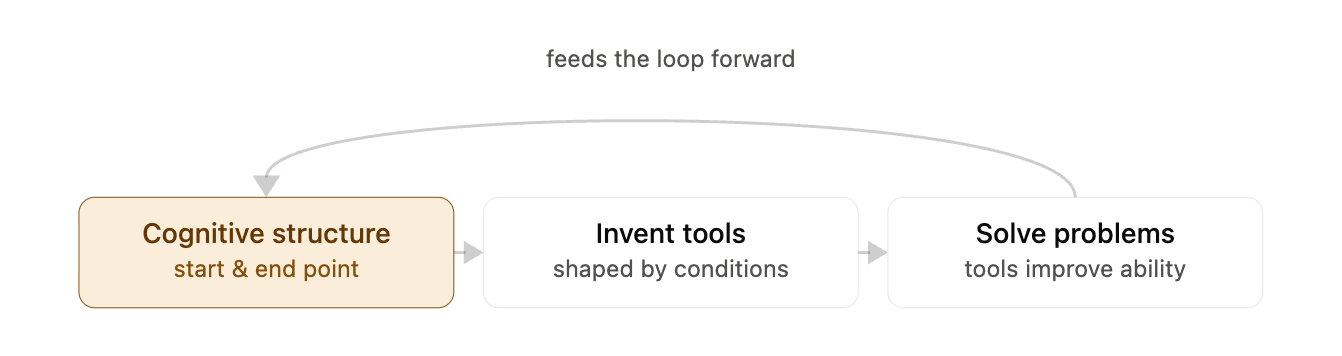
But today's technology has drifted from that purpose. It has a barrier to entry — how much you benefit from it correlates directly with your education and your ability to code. It's optimized for efficiency, to the point of forcing human life to revolve around technology's rhythm.
We should build tools that conform to how humans think, rather than forcing humans to think in the language of tools. Only when using a tool becomes intuitive can it truly and thoroughly act on human cognition and intelligence — becoming a real, effective capability that feeds back into the loop. Any tool capability that goes undiscovered or unused is capability wasted.
What does "augment" mean?
But what does real augmentation actually feel like? The flood of amazed reactions all over social media today still seems far from that endpoint. True augmentation doesn't make you consciously aware what technology has brought to you — it internalizes into your own capability, giving you the illusion that "my own ability has grown." For example, truly expanding the boundary of memory means external memory storage merges seamlessly with your real memory — effortless retrieval means you never carry the burden of forgetting, and searching an external memory store feels no different from recalling something yourself (We may still be a long way from that point, but today’s search engines already augment our memory capabilities considerably).
Augmentation is giving users superpower.
How tools augment intellect
Solving this problem requires returning to the human. In daily work and life, every complex task is a hierarchy built up from many micro-tasks. Solving a problem means organizing the relevant capabilities in our toolkit — reading, thinking, writing, communicating, and more granular capabilities still — to achieve some larger goal. At every step of this hierarchy, part of the work is done by tools, part by humans. In the past, we carried every step alone — trying to hold everything in our heads, keep everything within arm's reach. But once we learned to manipulate concepts, symbols, and tools, this hierarchy was reshaped, and we became able to accomplish more, and more complex, tasks. So to expand the boundary of our abilities further, humans keep inventing more tools, continually refining them to meet the demands of the environment — increasingly complex and increasingly personalized.
But the influence between humans and tools tends to run both ways. Marshall McLuhan, the father of media studies, once said: "We shape our tools and thereafter our tools shape us." Humans react to their environment — we think in the language of our tools. Changes in symbols, and changes in how we manipulate those symbols, both reshape the boundaries of our intelligence and cognition. For example, when writing is laborious, your ideas tend to become simpler.
Humans extend their intellect and cognition mainly through four media: physical tools, language, methodology, and training (Doug Engelbart's H-LAM/T framework). These media quietly weave themselves into every step of the "hierarchy" through which we accomplish any task, shaping and refining our thinking process, whether we notice it or not.
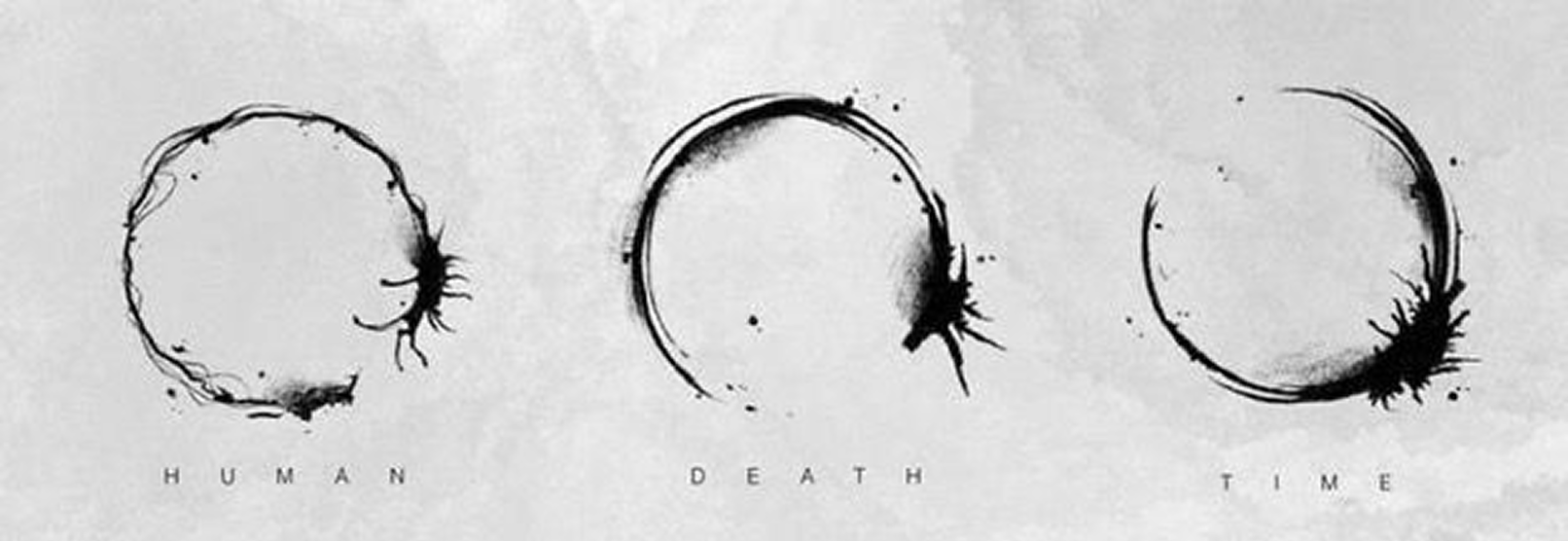
To maximize the augmentation and minimize capability overflow, tools need to speak humans' language of thought, in order for thinking to extend freely. Today's AI agents complete tasks in natural language — engineers no longer need to "translate" their ideas into the syntax of code. As the cost of translation drops, more ideas become worth trying. The closer a tool's language gets to human language, the wider the boundary of thought becomes. But can everything in our minds actually be described in natural language? Clearly not. Language collapses the richness of our thinking — the moment an idea is put into words, it loses the vividness it had in our minds. How to visualize systems of thought is a question worth exploring in its own right.
Every step we take today is a "prototype" of that ideal future state. As we keep pushing the boundary of invention, we shouldn't only think about what functions a tool itself should have — we also need to explore, in parallel, how and in what contexts it should be used. Given how much surplus capability LLMs already have, figuring out how to fully harness that capability is the more urgent problem to solve right now.
User interfaces unlock capabilities
Alan Kay, a key contributor to the GUI, said: "We need to unlearn some existing paths." Breaking free from the calcified cage of current interface design may be one of the most important efforts of our time. Looking back at the thinking behind Xerox PARC's original GUI design, Alan Kay drew on the three modes of human cognition — enactive, iconic, symbolic — to arrive at the design principle "Doing with Images creates Symbols." The environment of thought determines the quality of learning — thinking about the same thing by "doing," by "seeing," or by "abstract concept" produces completely different speed and depth of learning. A user interface needs to help the user shape the right environment to support thinking — which is exactly why they moved from symbolic commands to graphical interfaces: to let users form abstract concepts through action, rather than through symbols.
Back to the original theory: only tool capabilities that enter the loop are effective ones. A machine that acts on human intelligence first needs to be understandable, usable out of the box, and low in cognitive barrier — but that's still far from enough. There's a huge gap between using something proficiently and knowing how to use it well. A human-centered tool — one that sparks and encourages the creation of knowledge and ideas, and drives a shift in cognition rather than merely efficiency — is our north star.
We're living in an era pushed forward by the relentless pace of technological progress. But I hope that, just as the GUI once did, there can be a design brilliant enough to pull humanity back onto the stage.