My Thinking Pal
My thinking Pal is an attempt towards human-AI co-creation for creative tasks. You and the AI work the same surface at the same time — you put down a half-formed thought, it builds on it while you're still typing, and you build back on what it gives you. This isn't prompting, where you take turns and wait; it's jamming, the way musicians build on each other's lines instantly, but for thinking.
Stuck on a product strategy? Dump your scattered thoughts onto the canvas, and your AI pal starts shaping them into a structure while you're still thinking, pulling in how others have solved the same problem. Designing an app interface? Drop in a few reference images, and it goes hunting across the internet for better ones, then builds mini-demos you can click through, test, and throw away. The core goal is to close the gap of creativity: to catch an idea at the moment it tips into being — still vague, still fragile, one distraction away from gone — and keep working it until it can stand on its own. We want creators fully immersed in the flow state, while their AI pal handles the rest.
1. How idea formed: Tools shape how we think
In 1962, Douglas Engelbart argued that the means of manipulating symbols shapes intellect: that the limit of our intellect moves whenever the symbols we work with change, or our ability to manipulate them does. You can watch this happen right now. Natural language became a programming language, and people who had never written a line of code started shipping products. Nothing about their ideas changed. The language they had to speak to build them did. So the way to widen what people can think is to build tools that speak the language of thought itself — what Bret Victor calls media for thinking the unthinkable. Give someone the right representation and they can hold ideas that were previously out of reach.
This matters most for creative work. A good creator tool doesn't just record ideas. It makes them effortless to express, easy to strengthen, and fast to test.
A prompt box does none of this. The chat box kills creativity, because you have to know what you want before you can ask for it. Every query is a finished thought. But creativity doesn't arrive finished. It arrives sideways, out of coincidence and collision. "Creativity is just connecting things," Steve Jobs said, and you can't connect things you haven't put on the table yet.
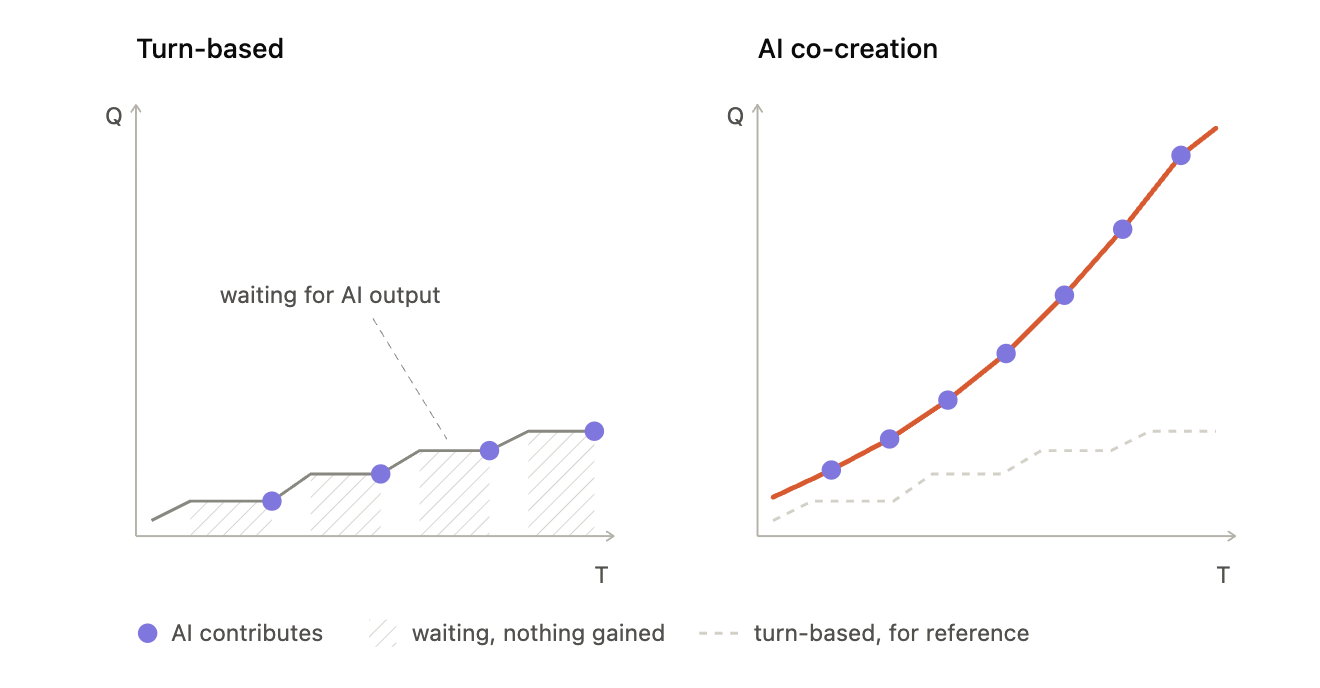
An idea left alone in a corner dissolves. An idea that gets echoed, questioned, argued with, and made specific gets stronger. That's what jamming does: the AI catches the idea worth catching and builds on it while it's still warm, and because every addition gives you something new to react to, the returns compound.
2. A co-creation space with AI
That led to my first attempt at building a co-creation tool with AI. Since I take all my notes in Obsidian, I built it there, as a plugin called Obsidian Genie. It comments in the margin as you write. It marks the point worth expanding. It brings back a similar project, an example, the supporting material your bullet was reaching for. And you never prompt it — that's the whole point. Genie absorbs what you've written, works out what you'd find useful, and pushes it to you at the right moment.
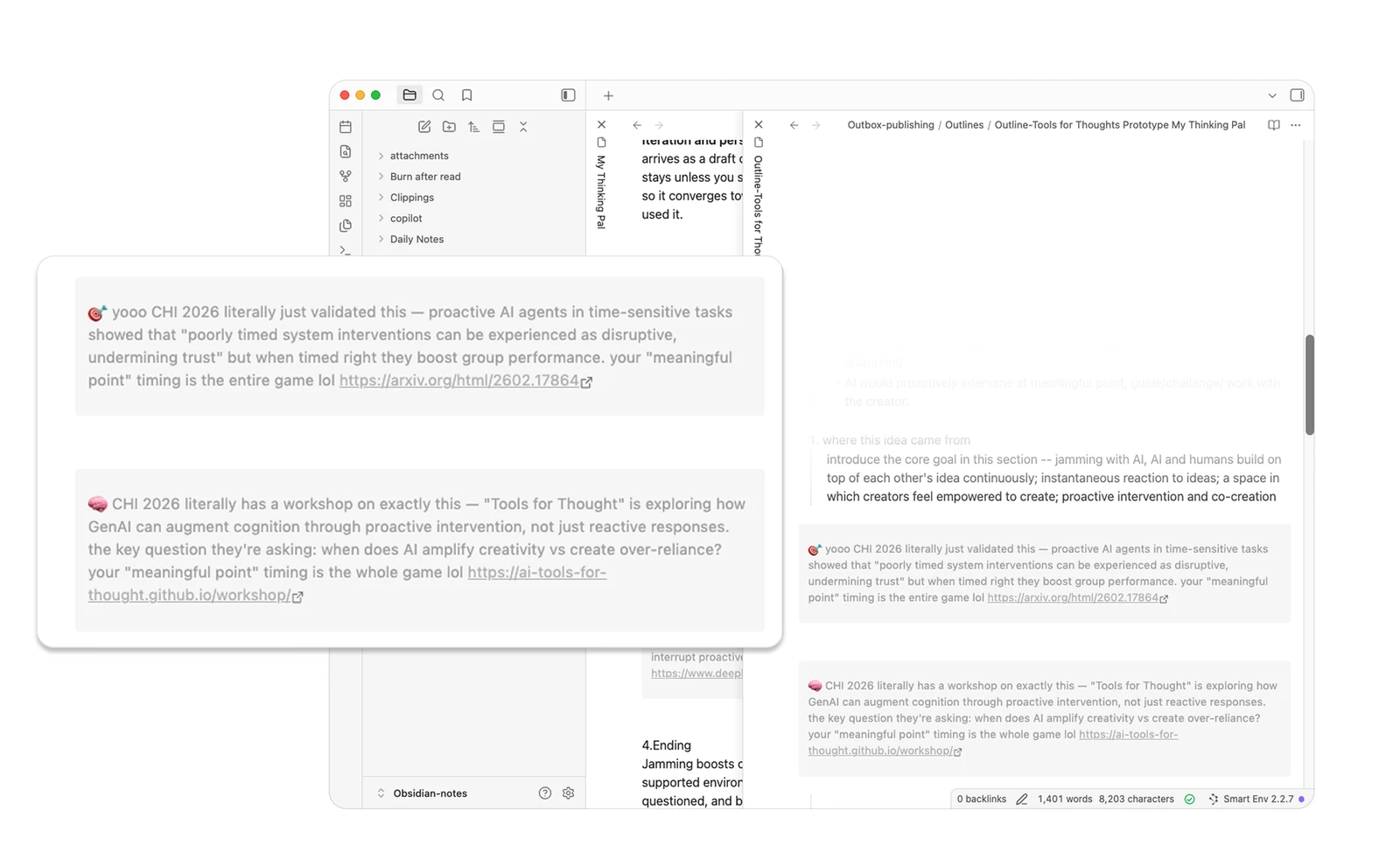
It didn't work the way I hoped, and the limit was what Genie could see. Living inside a note, the only signal it had was the text on the page. It didn't know whether you kept what it wrote or deleted it, whether you were typing fast or stuck, whether you'd just said something out loud that never made it onto the page. Read intent from one thin signal and the guesses stay generic. Also, I couldn't react to it or continue discussion in any ways. It comments, you read, and that's where it ends. Every run is a single run, and nothing compounds.
That led to My Thinking Pal, a creator canvas where the AI comments, responds, and co-creates with you. It sits with you while you think, whether you're talking out loud or typing in silence. Everything you say or write lands on an infinite canvas. Then the AI joins in. It offers a frame you hadn't tried, names the contradiction you talked past, finds the reference you half-remember, and builds a rough prototype when the idea is concrete enough to look at. A half-formed thought gets a real reaction while it's still half-formed, which is exactly when an idea is most able to grow, and most likely to be lost.
2.1 Key design philosophy
- The ideation loop: You react to what the AI adds, it reacts to what you do next, and the idea gains something on every pass. Ideas here don't accumulate. They compound.
- Timing and latency: To keep you in a flow state, what the AI offers has to arrive approximately at the same moment your attention is on it. The more real-time, the better. It reads what you're making as you make it, and decides whether to interrupt in the same breath.
- Being smart and relevant: What the AI offers has to cling to what you're actually reaching for. Anything outside your current focus isn't help, it's distraction. Which makes reading intent the hard problem, not generating content, so My Thinking Pal takes in every signal available while you create: what you say, what you type, where you halt, what you delete.
- Active trigger is always available: However good the judgment gets, it will sometimes stay quiet when you wanted it. One click brings it in. That covers the cost of a missed moment, and it keeps the trigger in your hands rather than the model's.
- A messy, non-linear workspace. Creativity comes from connections, and connections need things sitting next to each other. Ideas are also inherently multi-modal — a reference image does in one glance what a paragraph can't do at all. So images, GIFs, links, and text all live on the same surface, in whatever arrangement the thinking happens to take.
2.2 Tour of My Thinking Pal
The AI observer listens while you talk. Everything is transcribed in the background, but the panel surfaces only core insights. And once it reads what you're after, it starts contributing on its own — a note lands beside your work with an angle you hadn't taken, a tension between what you said ten minutes ago and what you're saying now, or a reference from someone who already tried this.
The AI co-creator writes alongside you, and it starts with what it already knows: the files you've uploaded for this project, what you said out loud during the meeting, what's already scattered across the canvas. Then it reads what you're reaching for rather than what you literally typed, and goes and gets it. Without being told what to look for, it searches on your behalf and comes back with reference images, projects that already solved a version of your problem, git repos worth reading, approaches you hadn't considered.
Summon is for the times you already know exactly what you want. It's one click away from anywhere on the canvas, at any point. A panel opens on the side, you talk it through there, and whatever turns out to be worth keeping drops back into your notes as bullets.
Iteration and personalization run on a single mechanic: everything the AI produces arrives as a draft carrying a yes and a no. Keep it or throw it away. Nothing it writes stays unless you say so. And every round takes the previous round's verdict as input, so it converges toward your taste rather than the average taste of everyone who ever used it.
3. Future improvements
As a project in progress, there are still some open problems waiting to be resolved in future versions.
- Timing. The trigger timing is still determined by a harness: a schedule outside the model that decides when it's allowed to speak. In the upcoming version I'm thinking of replacing that harness with an interaction model, so the AI co-creator can interrupt at real, meaningful points.
- Intention analysis. Reading what you're reaching for is the hardest part of the whole system, and it isn't consistent yet. Sometimes it lands exactly. Sometimes it offers something adjacent and useless. Until it's reliable, the value it adds stays uneven. The way forward is the loop itself: every accept and reject already tells the system what you actually wanted, and a stronger iteration model would feed those verdicts back into reading intent, not just into matching taste.
- More media. An idea is rarely just text. Right now the canvas holds text, images, and links; GIFs, animation, sound, and working demos still need to be added. The full picture of an idea usually needs several of these at once, and they should sit in the same space, so they can be connected and compounded later.
4. Ending
Jamming boosts creativity. My Thinking Pal is my attempt at a more immersive, better supported environment for creators — one where your ideas get strengthened, questioned, and built on by an AI partner. It's still very much a work in progress. The ultimate goal is bigger than one canvas: to build more humanized thinking tools that speak the language of our thoughts, and put them in the hands of every creator.